AI Baby Generator: Face Maker
- 4.6
- Rating
- 10.00M
- Installs
- Free
- Price
 Analysis by App-foxy
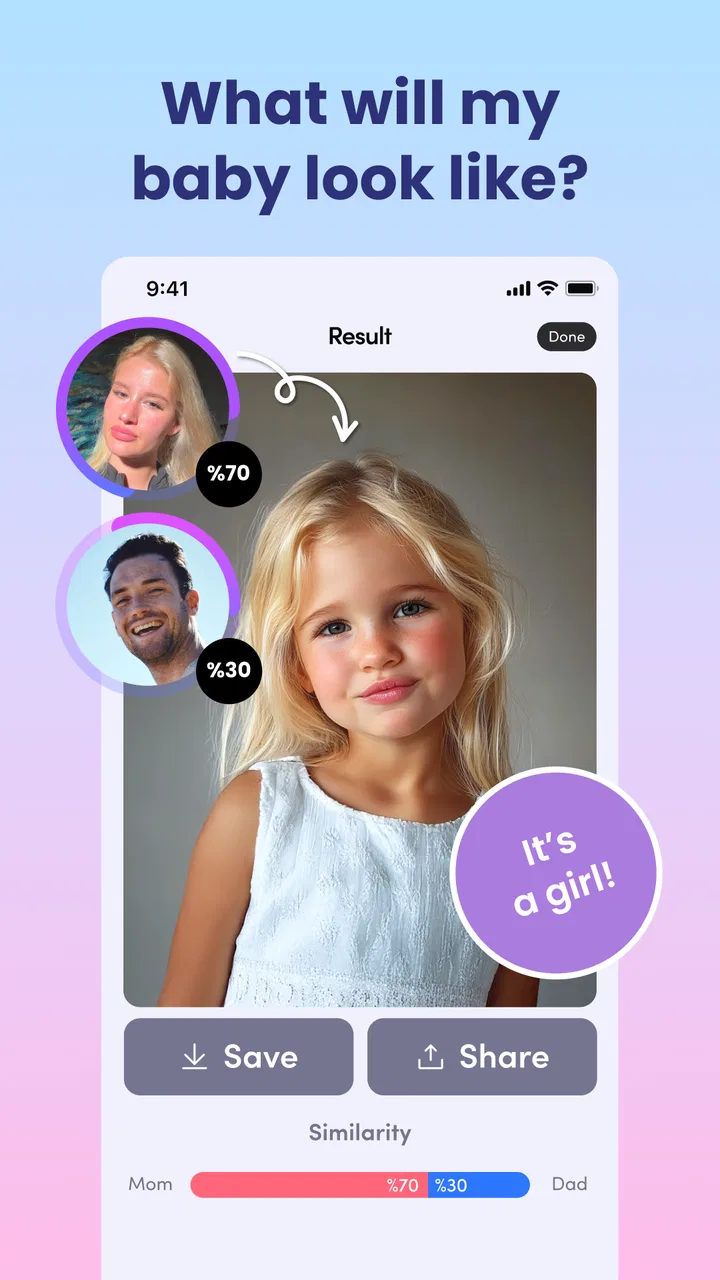
I tried AI Baby Generator: Face Maker as a lighthearted photography app, and its central idea is easy to understand: use faces to imagine what a future baby might look like. The appeal is not accuracy or prediction. It is the playful moment of seeing an AI-generated possibility and sharing a laugh, a surprise, or a sweet conversation with someone close to you.
That distinction matters from the start. I would not use this as a serious family-planning tool or treat the result as a realistic forecast. I see it as a visual experiment built around familiar photos. When approached that way, the app has a clear purpose and can be enjoyable, especially for couples, friends, and relatives who want a quick conversation starter rather than a carefully edited portrait.
It belongs to the photography category, is free to install, and is made by Wowoo AI Baby Generator: Face Maker. The app has built a substantial audience, with an average rating of 4.5 from around 243 thousand ratings and more than 10 million installs. Those figures suggest that the concept has broad appeal, although popularity alone does not make every generated result convincing.
You May Also Like

 Google Keep - Notes and lists
Google Keep’s Quiet Growth Shows the Appeal of Simpler Notes
As mobile work gets busier, Google Keep keeps winning a simple contest: capture a thought quickly, find it later, and get on with the day.

 Blood Strike: 2.5 Anniversary
Blood Strike’s Loadouts Turn Every Drop Into a Tactical Gamble
A close look at Blood Strike’s custom loadouts: how fast access to signature weapons reshapes its battle royale rhythm, rewards preparation, and narrows the gap between fights.

 Pandora - Music & Podcasts
Pandora’s Music Is Easy to Start, but Harder to Recover
Pandora’s strength is its low-effort path from a seed to a station. Its weak spot is how much confidence it asks you to place in connection, setup, and quiet recovery.

 8 Ball Pool
 Is Built on Rivalries, Rematches, and Routine
A close look at the rivalries, rematches, shared routines, and unanswered safety questions that turn a quick pool match into a persistent mobile community.

 Samsung Music
’s Quiet Strength Is Playing What You Already Own
Its reach comes less from spectacle than from dependable access to a personal library. That simplicity is both the app’s strongest retention engine and its ceiling.

 AccuWeather: Weather Radar
AccuWeather Review: A Quick, Clear Forecast for Everyday Decisions
For everyday plans, the best forecast is the one you can understand quickly. AccuWeather makes rain timing, radar, and local conditions easy to act on, with a few trade-offs.
More From Our News Desk



What the baby-face capability really adds
The interesting part is not simply placing two faces beside each other. The app turns a familiar photo-sharing habit into a guessing game. Instead of asking, “Which parent does the child resemble?” I can use the app to create an imagined answer and then compare the result with my own expectations.
That makes the output more useful socially than photographically. A normal camera app helps me preserve what is already in front of me. A standard portrait editor improves lighting, color, or framing. This tool does something different: it creates a speculative image that exists mainly for amusement. The value is in the reaction to the image, not in treating it as a biological prediction.
I found that the capability works best when the people involved understand the playful premise. A generated face can look charming, strange, or only loosely connected to the source photos. That variety is part of the experience, but it also means the result should not be judged by the same standards as a conventional portrait.
The app’s short description calls it an AI baby generator, while its longer store summary presents it as a way to guess a future baby’s look. In practice, I would describe it more carefully as a future-child face generator: a quick visual prompt for imagination, not a dependable look into the future.
Choosing photos makes more difference than expected
The first useful habit is to be selective about the images I use. A clean, front-facing photo usually gives the app a better visual starting point than a group picture, a heavily filtered selfie, or a face partly hidden by hair, sunglasses, or a hand. This is not a guarantee of a better result, but it reduces the chance that the app has to interpret too much visual clutter.
I also prefer photos with similar framing. If one face is a close-up and the other is a distant image, the generated result may feel less coherent. Matching the general angle and expression gives the final image a fairer comparison with the source material. This is one of the simplest ways to improve the experience without spending extra money or editing the photos first.
Another practical tip is to keep several suitable photos ready rather than repeatedly testing the first images in the camera roll. A clear image with even lighting is usually more useful than a dramatic photo that looks attractive to a person but hides important facial details. The app is built for quick experimentation, so preparing a small selection makes the process less frustrating.
How I use it in practice
I approach the app as a short sequence rather than a full photography project. I choose the faces, let the generator produce its interpretation, and then look at the result with the original images nearby. That comparison is important because it keeps the playful output in context. Without the source photos, it is easy to overread a familiar feature or assume that the image is more meaningful than it is.
When a result feels unusual, I do not immediately assume the app has failed. AI face generation can emphasize a particular feature in a way that looks exaggerated. I usually try a different pair of source photos before deciding whether the overall concept works for me. The change in input can make the experience feel more like a small creative test than a single yes-or-no prediction.
There is also a useful social workflow here. I can generate an image privately, save the one that feels most amusing, and show it to the other person later. That is better than sending every attempt, especially when some results look awkward. The app becomes a conversation tool rather than a machine that must deliver a polished image every time.
For a family group chat, I would keep the tone light and avoid presenting the image as a claim about a real child. For a couple, the fun may come from comparing several versions and debating which one has a familiar expression. For friends, the result can work as a humorous surprise. The same feature changes character depending on the people viewing it.
A realistic everyday scenario
Imagine two people sitting together after taking photos at home. They want something playful to do without setting up a game or learning an editing suite. One person chooses a clear portrait of each of them, runs the generator, and shows the result. The conversation quickly shifts to details: the eyes look like one person’s, the smile resembles the other, or the whole image looks completely unexpected.
That scenario is where I think the app makes the most sense. It takes only a short amount of attention, produces something visual, and gives people a reason to talk. It does not need to replace a photo editor, and it does not need to compete with a professional portrait service. Its strength is that it turns two ordinary images into a small shared activity.
The same workflow can be enjoyable during a family visit, but I would be more careful when children are involved in the conversation. Adults may understand the joke immediately, while a child could interpret the generated face too literally. I would explain that the image is an AI-made possibility and not a real prediction. That simple explanation keeps the activity fun without giving the output unnecessary authority.
Where it differs from ordinary photography apps
Compared with a standard camera app, this one gives up control in exchange for surprise. A camera app lets me decide the composition, focus, exposure, and moment. Here, the source photos matter, but the final interpretation is largely the point of the exercise. If I want a dependable family portrait, I would choose a conventional camera and editing app instead.
Compared with face filters, the experience is less about live performance and more about a finished imagined face. Filters are usually immediate and expressive; they can be entertaining because I see the effect while moving or posing. This app is better suited to a before-and-after reveal, where the anticipation is part of the fun.
Compared with manual photo compositing, it is much easier to start. I do not need to cut out faces, match skin tones, or align layers myself. The trade-off is precision. A careful editor can control exactly how two images are combined, while an AI generator may produce a result that is technically smooth but personally unconvincing.
That difference is important for expectations. People who enjoy creative control may find the app too limited. People who want a fast, low-effort surprise may appreciate that it removes the technical work. In my view, the app succeeds when speed and curiosity matter more than photographic accuracy.
The main trade-offs before regular use
The biggest limitation is the uncertain quality of the generated face. Some results may feel appealing because they combine recognizable traits, while others may look generic or oddly balanced. I would not install the app expecting every attempt to look natural. The experience depends heavily on the source images and on whether I am willing to treat unexpected results as part of the entertainment.
There is also a privacy consideration whenever personal faces are used with an AI photography service. I would think carefully before uploading photos of someone who has not agreed to the experiment, particularly children or people outside my household. The safest everyday habit is to use images with permission and avoid treating other people’s faces as disposable material for a joke.
The app is free to install, but it includes in-app purchases ranging from forty-nine cents to forty-nine dollars and ninety-nine cents per item. That makes it worth paying attention during use. I would begin with the free experience, understand what is available, and avoid assuming that every option or repeated generation is included at no cost. The wide purchase range means the app can suit casual users, but it also deserves a deliberate approach to spending.
Another trade-off is emotional. A generated baby face can be amusing for one person and uncomfortable for another. It may touch on sensitive subjects such as relationships, fertility, family expectations, or appearance. I would not use it as a surprise on someone who might feel pressured by the topic. The app is at its best when everyone involved has already agreed that the exercise is just imaginative.
The age rating is Everyone, which fits the simple, non-game photography concept. Even so, an Everyone rating does not remove the need for adult judgment about photo sharing, personal boundaries, and how the generated image is explained. The content may be broadly accessible, but the social context still matters.
How to get more useful results without overthinking them
My first recommendation is to test with natural expressions. A posed smile can make the output feel like a blend of smiles rather than a believable face. A relaxed portrait may produce a result that is easier to compare with the people in the source images. I would also avoid mixing a heavily edited image with an unedited one, because the visual differences can distract from the result.
My second recommendation is to compare, not collect. It is tempting to generate many versions and keep searching for the “right” face. That can turn a quick activity into a cycle of judging tiny differences. I prefer making a small number of attempts with carefully chosen photos, then selecting the image that creates the most enjoyable conversation.
My third recommendation is to save context with the image when sharing it. A short note such as “just for fun” helps prevent relatives or friends from reading the result as a prediction. This is especially useful when the image leaves the original conversation and appears later in a group chat or social feed.
Finally, I would treat the app as an occasional activity rather than a daily photography tool. Its novelty is a major part of its appeal. Repeating the same experiment too often can make the results feel less surprising, while using it at the right moment keeps the experience fresh.
Who is most likely to enjoy it
This app is a good match for people who like casual AI experiments, playful photo sharing, and low-effort conversation starters. Couples may enjoy comparing imagined family features. Friends can use it for a humorous reveal. Families may appreciate it as a short activity during a gathering, provided everyone understands the result is fictional.
It is also suitable for someone who wants to explore AI-generated photography without learning complicated editing controls. The central workflow is approachable, and the free starting point lowers the barrier to trying it. The current version is 5.4.24, and the app requires at least OS 11, so device compatibility is something I would check before installing, particularly on an older phone or tablet.
I would skip it if my goal were accurate genetics, professional image editing, a carefully controlled portrait, or a live camera filter. I would also avoid it if I am uncomfortable using personal face photos in an AI-based experience or if the subject of future children could create tension in my relationship or family. In those cases, a regular photo editor, a camera app, or no app at all would be the better choice.
After using it, my opinion is positive but deliberately limited. AI Baby Generator: Face Maker is entertaining when I treat it as a shared guessing game, not as a prediction engine. Its best feature is the way it turns familiar portraits into an unexpected conversation. Its weaknesses are equally clear: results can vary, privacy deserves thought, and purchase options require attention.
For a free photography app with an Everyone rating and a large existing audience, it is easy to try, but I would keep expectations realistic. Choose respectful, well-framed photos, compare a few results rather than chasing perfection, and explain the image honestly when sharing it. Used that way, it offers a distinctive little experience that ordinary camera apps and manual editors do not provide.
FAQs for AI Baby Generator: Face Maker
01What is AI Baby Generator: Face Maker and how does it work?
AI Baby Generator: Face Maker is an innovative app that uses advanced artificial intelligence algorithms to predict and generate images of what a future baby might look like by analyzing photos of two individuals. Users simply upload photos, and the app combines facial features to create a potential image of their child.
02Is AI Baby Generator: Face Maker safe and secure to use?
Yes, the app is designed with user privacy in mind. It ensures that all uploaded photos are processed securely and are not stored on the server after the image generation is complete. Always check the app’s privacy policy for detailed information on data handling practices.
03Are the generated baby images accurate and realistic?
While AI Baby Generator: Face Maker uses sophisticated algorithms to create realistic images, the results are speculative and meant for entertainment purposes. Variability in genetic traits means that actual outcomes may differ significantly from the app's predictions.
04What devices are compatible with AI Baby Generator: Face Maker?
AI Baby Generator: Face Maker is available for both Android and iOS devices. It supports most smartphones and tablets running on recent operating systems. Ensure your device has the latest updates for optimal performance and compatibility.
05Are there any costs associated with using AI Baby Generator: Face Maker?
The app offers free basic features, but some advanced functionalities may require in-app purchases or subscriptions. Check the app store for detailed pricing information and any available promotional offers that might benefit you.
Pros
- Easy to use with intuitive interface.
- Generates realistic baby images quickly.
- Includes diverse customization options.
- Fun and entertaining for families.
- Compatible with both Android and iOS.
Cons
- Limited free features; in-app purchases required.
- Occasional crashes on older devices.
- Privacy concerns over photo uploads.
- Requires internet connection to function.
- Ads can be intrusive during use.

AI Baby Generator: Face Maker
Gallery